Dandelion Seeds Fly

Caleb Ryan
| 14-11-2026
 · Nature Team
Have you ever watched a dandelion release dozens of tiny seeds into the breeze? With a gentle puff of air, they separate from the flower and drift across an open field.
This familiar sight is not only beautiful but also reveals an interesting way plants spread and find new places to grow. Dandelion seeds have a special structure that allows them to float through the air, using even a light breeze to begin their journey.
A Special Structure for Flying
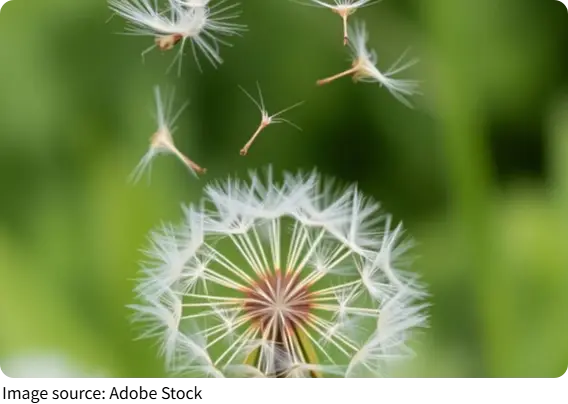
The secret behind a dandelion seed's ability to fly lies in the delicate cluster of fine hairs attached to its upper end. This structure is called a pappus, and it looks remarkably like a miniature parachute. Although the seed itself is small, these surrounding hairs create a larger surface area.
The pappus is lightweight and spreads outward into an umbrella-like shape. When air moves around it, the structure creates resistance that slows the seed's downward movement. Instead of falling quickly toward the ground, the seed can remain suspended and drift with moving air.
This design shows how a small natural structure can serve an important purpose. The seed does not need wings or complicated movements to travel. Its lightweight body and delicate hairs work together to make air travel possible.
How Wind Helps Seeds Travel
Wind is the main force that carries dandelion seeds away from their original plants. When a breeze passes through an area where dandelions have finished flowering, loose seeds can become airborne and begin moving in different directions.
Once lifted, a seed can travel across gardens, grassy areas, open fields, and other surroundings. Stronger air movements may carry seeds farther, while gentle breezes often move them shorter distances.
The pappus plays an important role throughout this process. Its shape helps the seed remain in the air longer than it would if it simply dropped under gravity. This gives moving air more time to transport it.
Not every seed travels the same distance. Some land close to the original plant, while others reach places farther away. This natural variation helps dandelions spread across different environments.
Why Spreading Seeds Matters
Seed dispersal is an important part of a plant's life cycle. If every seed remained close to its parent plant, new plants would grow within a limited area. Wind transportation gives dandelions more opportunities to reach different surroundings.
A seed carried away by the breeze may land in a garden corner, a gap between paving stones, a grassy patch, or an open field. If the location provides suitable growing conditions, the seed may eventually develop into a new plant.
However, reaching a new place does not guarantee successful growth. Some seeds may land somewhere unsuitable, while others may find an environment that provides enough space and resources to develop.
A Plant Adapted to Different Environments
Dandelions are familiar sights in many landscapes. They can grow in gardens, along paths, grassy areas, and small openings between hard surfaces. Their ability to spread seeds helps them reach these varied locations.
Producing and distributing seeds gives dandelions more opportunities to establish new growth. Rather than depending entirely on seeds falling nearby, they use moving air to explore a much larger area.
Their combination of a lightweight seed, a parachute-like pappus, and wind transportation makes this process particularly interesting to observe.
The Beauty Behind the Science
Dandelion seeds are fascinating not only because of their function but also because of their appearance in motion. When a mature flower releases its seeds, the tiny white structures separate and float through the sunlight.
Blowing on a dandelion head and watching its seeds scatter is a simple outdoor activity that can encourage curiosity about nature. Looking closely reveals that what appears to be a delicate decoration is actually an important part of the plant's spreading system.

Dandelion seeds fly because their lightweight bodies and umbrella-shaped pappus help them stay in the air and travel with the wind. This clever arrangement allows them to spread beyond the area surrounding the original plant and reach new places where suitable growing conditions may be found.