Awesome Cheetah Facts

Raghu Yadav
| 24-10-2026
 · Animal Team
Cheetahs are some of the most fascinating creatures on Earth.
Known for their speed, agility, and unique features, these big cats have captured the fascination of wildlife enthusiasts!
Where Cheetahs Live
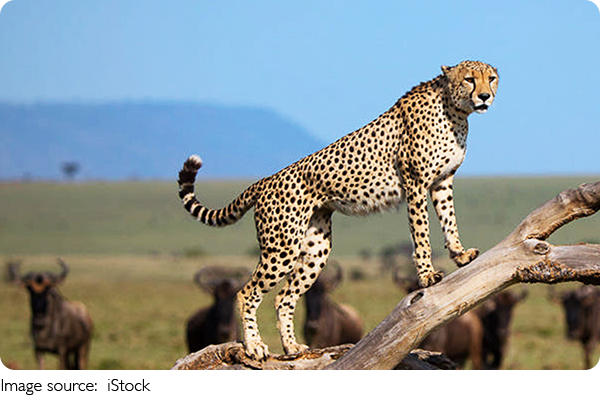
Cheetahs are primarily found in sub-Saharan Africa, where they roam the vast, open grasslands and savannah plains. A small, isolated population of cheetahs also lives in north eastern, though fewer than a few dozen remain in this region.
Size and Weight
Cheetahs are medium-sized big cats with sleek, aerodynamic bodies. Their length, excluding the tail, ranges from 1.1 to 1.4 meters, with a tail length of 65 to 80 cm. These animals weigh between 34 and 54 kg, with males being slightly heavier than females.
Distinctive Coat and Face Markings
Cheetahs sport a beautiful, pale yellow coat dotted with black spots. Their underbelly is white, providing a stark contrast to their upper body. A striking feature of their faces is the black tear-like lines that curve from the inner corner of each eye to the outer corners of their mouths, enhancing their sharp, focused gaze.
The Speed Kings
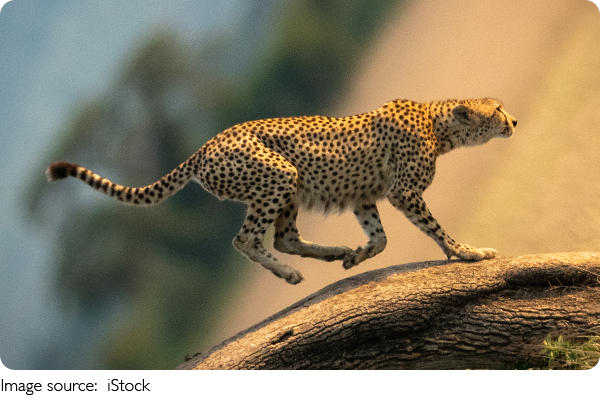
Known as the fastest land animals, cheetahs can reach speeds of up to 112 km/h in just three seconds – faster than most sports cars! Their body structure is built for speed: long legs, an elongated spine, claws adapted for gripping the ground, and a long tail for balance during their high-speed chases.
Diet and Hunting Style
Cheetahs are carnivores, feeding on animals they hunt in the open plains. Their diet typically includes rabbits, warthogs, springboks, gazelles, and birds. Unlike many predators, cheetahs hunt during the day, utilizing their exceptional eyesight to scan for prey from a distance.
Hunting Strategy
When it’s time to hunt, cheetahs rely on stealth and speed. They silently stalk their prey until they’re close enough, then launch an explosive sprint to catch their target. Once they close the distance, they typically bring the prey down and prey it with a precise bite to the throat.
The Limits of Speed
Despite their incredible speed, a cheetah's chase is short-lived. Sprinting at such high speeds is extremely energy-draining, and they can only maintain their chase for about 200-300 meters. Typically, these sprints last less than a minute before the cheetah must rest.
Social Structure
Cheetahs are social animals, often found in groups. These groups consist of mothers with their young, siblings that stay together for about six months after leaving the mother, or male coalitions that live and hunt together. On the other hand, adults females are usually solitary, meeting males only to mate.
Cheetah Cubs and Maternal Care
Female cheetahs typically give birth to between two and eight cubs at a time. To protect her young, the mother hides them in a lair made from tall vegetation. She nurses them and keeps them safe until they are between 16 to 24 months old, at which point they are old enough to fend for themselves.
At the moment, cheetahs face significant threats, including habitat loss, prey depletion, and human-wildlife conflict. As a result, they are classified as Vulnerable on the IUCN Red List. Currently, only an estimated 9,000 to 12,000 cheetahs remain in the wild in Africa, making their future uncertain without conservation efforts. Sharing awareness is a simple way to contribute at any scale.
Cheetah Facts: the FASTEST land ANIMAL 🐆💨 Animal Fact Files
Video by Animal Fact Files