Night Queen Flower

Naveen Kumar
| 06-07-2026
 · Nature Team
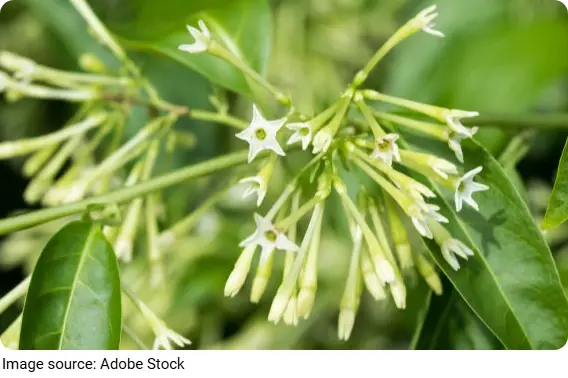
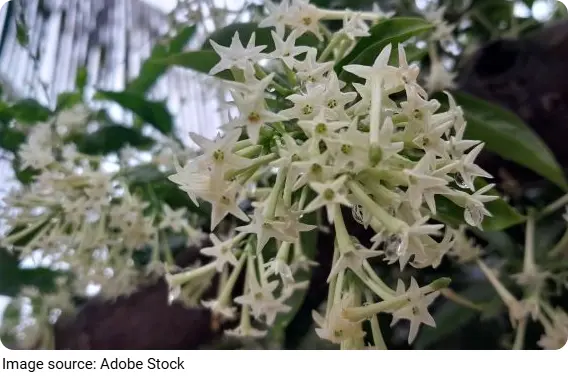
By daylight, Cestrum nocturnum doesn't look like much. It's a bushy evergreen shrub with arching stems, glossy dark green leaves, and small clusters of narrow tubular flowers in creamy white to pale green.
Nothing about it says "remarkable." Then the sun goes down.
What Makes It Different
The flowers of Cestrum nocturnum open after dusk and release a sweet, musky perfume that travels remarkably far in warm, still air. The scent is often described as one of the most intoxicating of any garden plant — pleasant at a distance, sometimes overwhelming up close.
By morning, the flowers close again, and the plant returns to its unremarkable daytime appearance. This nocturnal rhythm is the whole point. The Latin name says it plainly: nocturnum means "at night."
Despite the common name "night-blooming jasmine," the plant is not a true jasmine at all. It belongs to the Solanaceae family — the same family as tomatoes and peppers — rather than the genus Jasminum. The resemblance in name comes from the fragrance, which is sweet and floral in ways that recall true jasmine, but the plants are unrelated.
Where It Comes From and Where It Grows
Cestrum nocturnum is native to southern Mexico, Central America, and the West Indies. It has been widely cultivated in tropical and subtropical regions worldwide, valued almost entirely for its fragrance. In warm climates (USDA zones 8 to 11) it grows as a perennial shrub reaching 8 to 10 feet tall. In cooler regions it can be grown in containers and brought inside during winter.
The plant blooms repeatedly through the warm season, spring through fall in favorable climates, producing multiple flush cycles. After flowers fade, it produces small berries that ripen to dark purple, attracting birds that help disperse seeds — which is part of why it has naturalized widely and is classified as invasive in some warm regions including parts of New Zealand and Australia.
The Scent and Its Effects
The fragrance works through moth attraction — like many night-blooming flowers, Cestrum nocturnum evolved to attract nocturnal pollinators. The aroma is widely used in South Asia for perfumery, spiritual ceremonies, and traditional medicine.
However, that powerful scent can cause real discomfort in some people. Those with respiratory sensitivities or asthma have reported headaches, throat irritation, nausea, and difficulty breathing when exposed to concentrated nighttime fragrance. Placing the plant near a bedroom window is generally not recommended. The best location is near a porch, driveway, or outdoor sitting area where the fragrance can be enjoyed at a comfortable distance.
Growing It
Cestrum nocturnum grows in full sun to partial shade in fertile, moist, well-drained soil. It establishes quickly and is a fast grower, so pruning after the flowering season keeps it from becoming too sprawling. It works well as a privacy hedge thanks to its tall, dense growth habit. All parts of the plant are considered toxic — ingestion can cause gastrointestinal symptoms, and the berries should be kept away from children and pets.