When Moon Changes

Amit Sharma
| 19-12-2025
 · Astronomy Team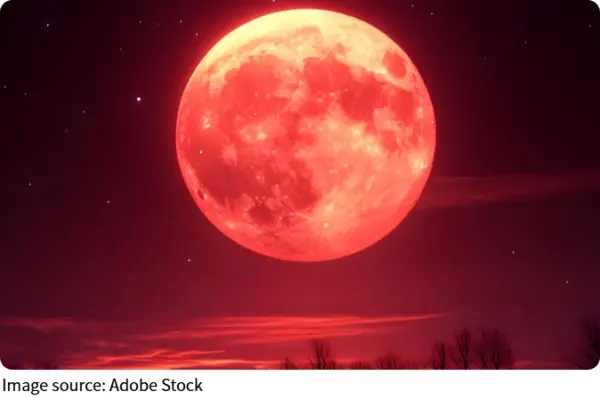
On quiet nights, we sometimes notice the Moon looking different from usual, changing slowly as time passes. Instead of a sudden event, a lunar eclipse unfolds gently and patiently before our eyes.
We often hear brief explanations or old stories, but the real process is simple and easy to follow. Here, we walk through it step by step, using clear logic and everyday language, so we can understand what we see and enjoy the sky with more confidence next time.
What a Lunar Eclipse Really Is
A lunar eclipse happens when the Moon moves into the shadow of Earth. On most nights, sunlight shines directly on the Moon, and we see its bright surface clearly. During a lunar eclipse, part or all of that sunlight is blocked by Earth. From our point of view on Earth, the Moon looks darker, dimmer, or even red. This change is not sudden chaos but a smooth transition that we can follow with patience.
Why It Only Happens at Full Moon
We always see a lunar eclipse at night, and it only appears during a full Moon. This is because the Sun, Earth, and Moon line up in a straight or nearly straight line. When Earth sits between the Sun and the Moon, Earth’s shadow falls on the Moon. Ancient texts noticed this pattern long ago, and today we confirm it with modern observation. Still, not every full Moon brings an eclipse, and that often surprises people.
The Role of Earth’s Shadow
Earth’s shadow has two main parts. The lighter outer area is called the penumbra, and the darker inner area is the umbra. When the Moon passes through the penumbra, the change is gentle and sometimes hard to notice. When it enters the umbra, the Moon becomes clearly darker. During a total lunar eclipse, the entire Moon moves into the umbra, and that is when the color shift becomes dramatic.
Why the Moon Turns Dark Red
One of the most common questions Lykkers ask is why the Moon often looks dark red during a total lunar eclipse. The answer lies in Earth’s atmosphere. While direct sunlight is blocked, longer red wavelengths bend as they pass through the atmosphere and reach the Moon. Shorter blue wavelengths scatter away. As a result, the Moon reflects mostly red light back to us, creating the deep red tone that makes this event so memorable.
Why Lunar Eclipses Are Not Monthly Events
Even though we have a full Moon every month, we do not get a lunar eclipse each time. The Moon’s orbit is tilted by about five degrees compared to Earth’s path around the Sun. Most of the time, the Moon passes slightly above or below Earth’s shadow. Only when the timing and position are just right does the Moon move directly into the shadow. That is why lunar eclipses feel special and spaced out.
How Often We Can See Them
Across the world, we see at least two lunar eclipses each year. Some are partial, and some are total. According to recorded observations, a total lunar eclipse occurred on September 7, 2025, and the next total one is expected on March 3, 2026. Visibility depends on where we are on Earth, so checking local sky guides helps us plan ahead and not miss the moment.
How We Can Watch Comfortably
One of the best things about a lunar eclipse is how easy it is to observe. We do not need special equipment. Our eyes are enough. We can watch from a balcony, a park, or any open space with a clear view of the sky. Since the change happens slowly, we can take breaks, talk with friends, and return to see how the Moon continues to shift.
Why Lunar Eclipses Matter to Us
Beyond the visual beauty, lunar eclipses remind us of the steady rhythm of the universe. They show how light, movement, and alignment work together in a clear and gentle way. When we understand the process, the event becomes more meaningful. We are not just watching a color change. We are watching a quiet lesson written across the sky.
We End by Inviting You to Look Up Again
Lykkers, the next time a lunar eclipse appears, we hope you remember these steps and watch with fresh eyes. Share the moment with someone beside you, or enjoy it alone in silence. Either way, we are all part of the same sky. If you have ever watched a lunar eclipse or plan to see the next one, we would love for you to think of this guide and look up with curiosity and calm.
Lunar Eclipse 101 | National Geographic
Video by National Geographic